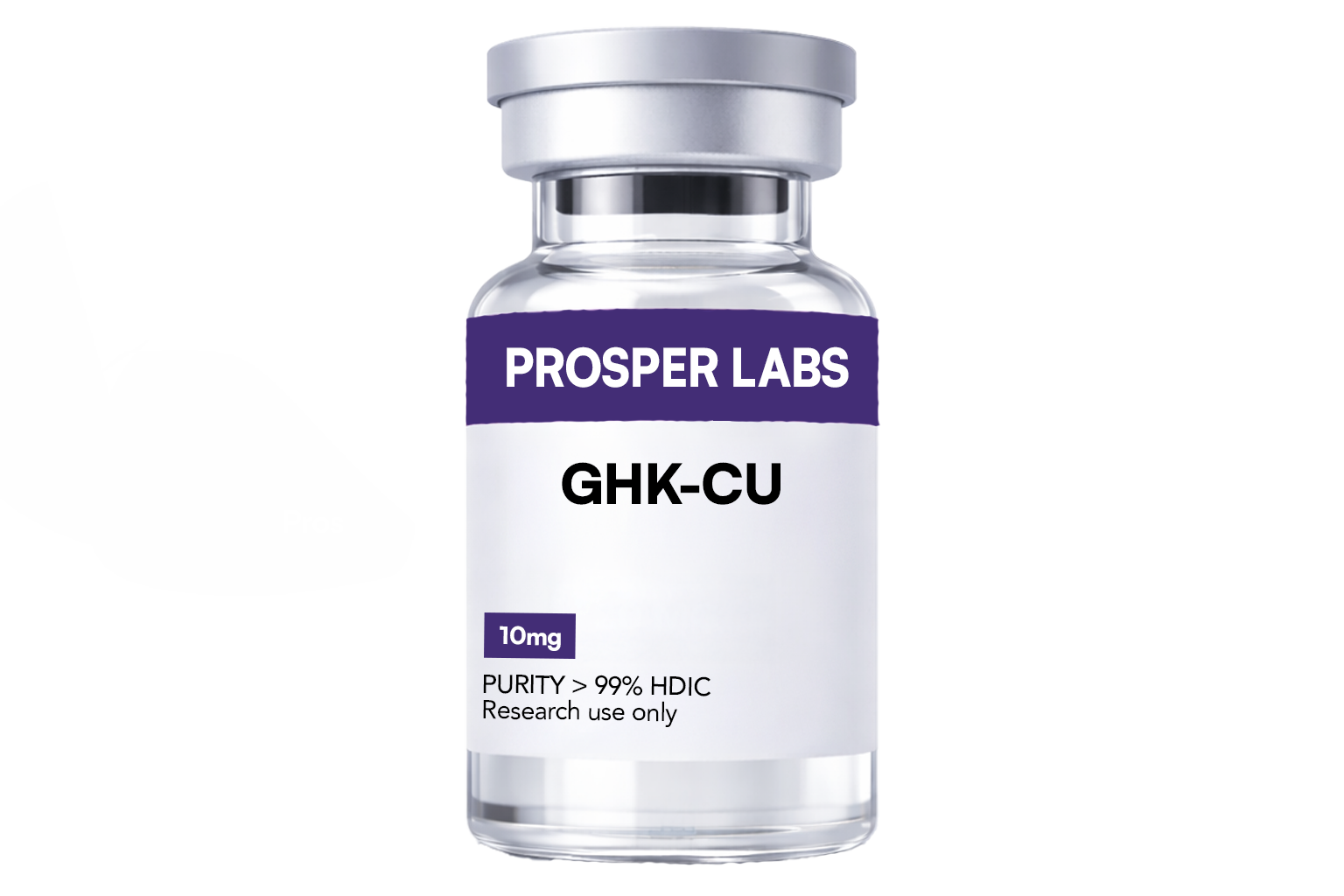
GHK-CU
Product Description
GHK Cu Copper Tripeptide 1 Copper Peptide Complex | Research Use Only
What it is
GHK Cu is the copper(II) complex of the naturally occurring tripeptide GHK, which stands for glycyl L histidyl L lysine. In cosmetic ingredient naming, it is commonly referred to as Copper Tripeptide 1. It is widely studied in skin biology research and cosmetic science because copper binding can influence pathways involved in extracellular matrix signaling and visible skin quality, but it is not an FDA approved drug. (pubchem.ncbi.nlm.nih.gov) (pmc.ncbi.nlm.nih.gov)
Origins and development
GHK was first identified in human plasma and became a major focus of research led by Loren Pickart and collaborators, with later publications expanding into mechanistic and gene expression discussions for skin and regenerative biology. Modern review literature summarizes this discovery history and the subsequent research expansion into dermatologic and tissue repair models. (pmc.ncbi.nlm.nih.gov) (pmc.ncbi.nlm.nih.gov)
Molecular profile
GHK tripeptide and its copper complex are listed in chemical registries with distinct molecular weights. PubChem lists GHK at 340.38 g per mol, and the copper complex Cu GHK at 403.92 g per mol. (pubchem.ncbi.nlm.nih.gov) (pubchem.ncbi.nlm.nih.gov)
In cosmetic labeling, the ingredient is commonly referenced as Copper Tripeptide 1, which appears in cosmetic safety reviews of peptide ingredients and their metal salts. (cir-safety.org)
Scientific overview
GHK Cu is studied as a copper binding peptide complex with reported biological activity in skin related models, including signaling linked to collagen and extracellular matrix processes, antioxidant associated pathways, and inflammatory response modulation. Much of the supportive evidence base is preclinical or mechanistic, and review literature emphasizes that translation depends on formulation, delivery, study design, and the quality of human data. (pmc.ncbi.nlm.nih.gov) (pmc.ncbi.nlm.nih.gov)
Clinical research
Human evidence for topical cosmetic use is discussed in the context of skin appearance and conditioning, but the strongest and most consistent literature base remains cosmetic and preclinical rather than drug development. Ingredient safety has been reviewed for cosmetic use categories by independent review bodies for peptide ingredients and related salts. (cir-safety.org)
What researchers study with GHK Cu
Key research focus areas often include
• Skin extracellular matrix and collagen related signaling in cellular and tissue models (pmc.ncbi.nlm.nih.gov)
• Gene expression and pathway level hypotheses described in literature reviews (pmc.ncbi.nlm.nih.gov)
• Formulation behavior and stability considerations for copper peptide complexes in topical systems (cir-safety.org)
Regulatory and compliance notice
Research Use Only. Not for human or veterinary use. Copper tripeptide ingredients are discussed in cosmetic safety assessments, but this product is not being offered as an FDA approved drug and must not be marketed for diagnosis, cure, mitigation, treatment, or prevention of disease. Cosmetic ingredient safety reviews should not be interpreted as drug approval. (cir-safety.org)
Citations and references
-
PubChem. Cu GHK compound record, includes molecular weight and identifiers.
(pubchem.ncbi.nlm.nih.gov) -
PubChem. Glycyl L histidyl L lysine compound record, includes molecular weight for GHK.
(pubchem.ncbi.nlm.nih.gov) -
Pickart L. Regenerative and Protective Actions of the GHK Cu Peptide in the Body, review article. International Journal of Molecular Sciences (2018).
(pmc.ncbi.nlm.nih.gov) -
Pickart L and colleagues. GHK Peptide as a Natural Modulator of Multiple Cellular Pathways, review and mechanistic discussion. (2015).
(pmc.ncbi.nlm.nih.gov) -
Cosmetic Ingredient Review. Safety Assessment of Tripeptide 1 and related peptides and their metal salts as used in cosmetics, includes copper peptide related ingredient categories.
(cir-safety.org)
COA Testing
The Certificate of Analysis for this product is shown directly below for easier review.
Certificate of Analysis coming soon
COA will display here once attached.