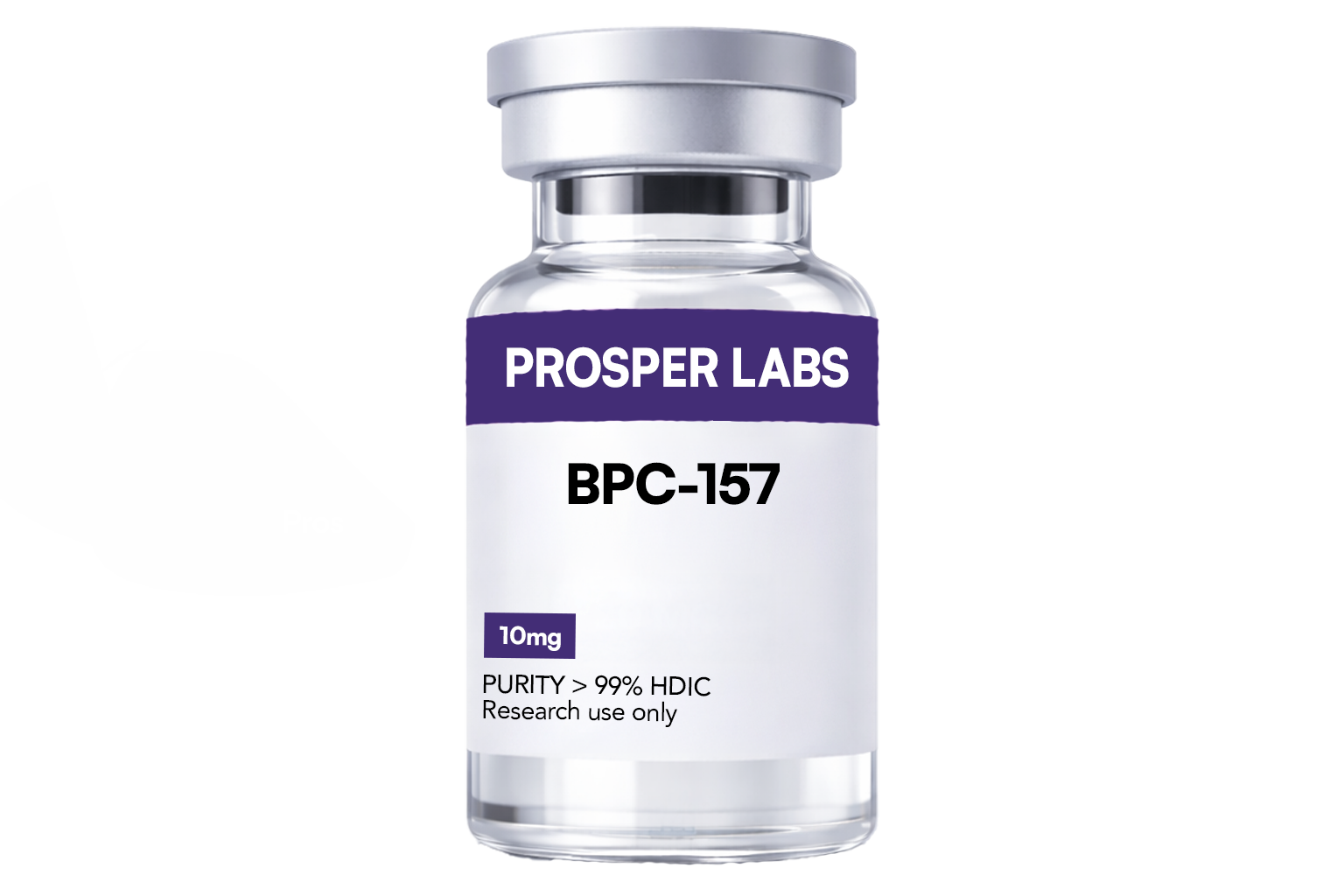
BPC – 157
Product Description
BPC 157 Body Protective Compound 157 | Research Use Only
What it is
BPC 157, short for Body Protective Compound 157, is a synthetic pentadecapeptide meaning a 15 amino acid peptide that originated from research on protective peptides found in human gastric juice. It is widely studied in preclinical models for tissue and organ protection, but high quality human evidence remains limited and it is not an FDA approved drug.
Origins and development
BPC 157 was introduced in the scientific literature as a gastric derived peptide fragment associated with cytoprotective research, and later became widely investigated across animal models. Modern literature reviews describe it as a 15 amino acid fragment associated with gastric juice research and early publications from the 1990s.
Molecular profile
BPC 157 is commonly referenced with the amino acid sequence below, and many technical sources report a molecular weight around 1419.5 daltons.
Sequence
Gly Glu Pro Pro Pro Gly Lys Pro Ala Asp Asp Ala Gly Leu Val
Chemical registry context
PubChem lists BPC 157 with formula C62H98N16O22, and PubChem separately lists a common salt form BPC 157 acetate.
Scientific overview
Most published work on BPC 157 is preclinical, where researchers explore cytoprotection, soft tissue repair models, and vascular and inflammatory signaling hypotheses. A recent literature and patent review notes broad mechanistic claims across many pathways, but also emphasizes gaps in rigorous human evidence and the need for better characterized safety data.
Clinical research
Human clinical data are limited. A Phase 1 clinical trial record exists on ClinicalTrials.gov that aimed to evaluate safety and pharmacokinetics in healthy volunteers, but public results have been limited.
Because the evidence base is heavily weighted toward animal studies, conclusions about efficacy and safety in humans remain uncertain.
What researchers study with BPC 157
Key research focus areas often include
• Tissue repair models such as tendon, ligament, muscle, and gastrointestinal injury models in animals
• Pharmacokinetics and distribution in animal models, including rat and dog studies
• Mechanistic hypotheses involving angiogenesis and inflammatory signaling, while noting uncertainty and the need for higher quality translational research
Regulatory and compliance notice
Research Use Only. Not for human or veterinary use. The FDA lists BPC 157 as a Category 2 bulk drug substance under certain compounding policies and notes potential significant safety risks, including immunogenicity risk and limited safety information for proposed routes of administration.
Citations and references
-
Józwiak M, Bauer M, Kamysz W, Kleczkowska P. Multifunctionality and Possible Medical Application of the BPC 157 Peptide, literature and patent review. Pharmaceuticals (2025).
https://www.mdpi.com/1424-8247/18/2/185 -
FDA. Certain bulk drug substances for use in compounding that may present significant safety risks, includes BPC 157 Category 2 entry.
https://www.fda.gov/drugs/human-drug-compounding/certain-bulk-drug-substances-use-compounding-may-present-significant-safety-risks -
ClinicalTrials.gov. NCT02637284, safety and pharmacokinetics trial entry for BPC 157.
https://clinicaltrials.gov/study/NCT02637284 -
He L, et al. Pharmacokinetics, distribution, metabolism, and excretion of BPC 157 in rats and dogs. Frontiers in Pharmacology (2022).
https://www.frontiersin.org/journals/pharmacology/articles/10.3389/fphar.2022.1026182/full -
PubChem. BPC 157 compound record and BPC 157 acetate record.
https://pubchem.ncbi.nlm.nih.gov/compound/Bpc-157
https://pubchem.ncbi.nlm.nih.gov/compound/BPC-157-acetate
COA Testing
The Certificate of Analysis for this product is shown directly below for easier review.
Certificate of Analysis coming soon
COA will display here once attached.