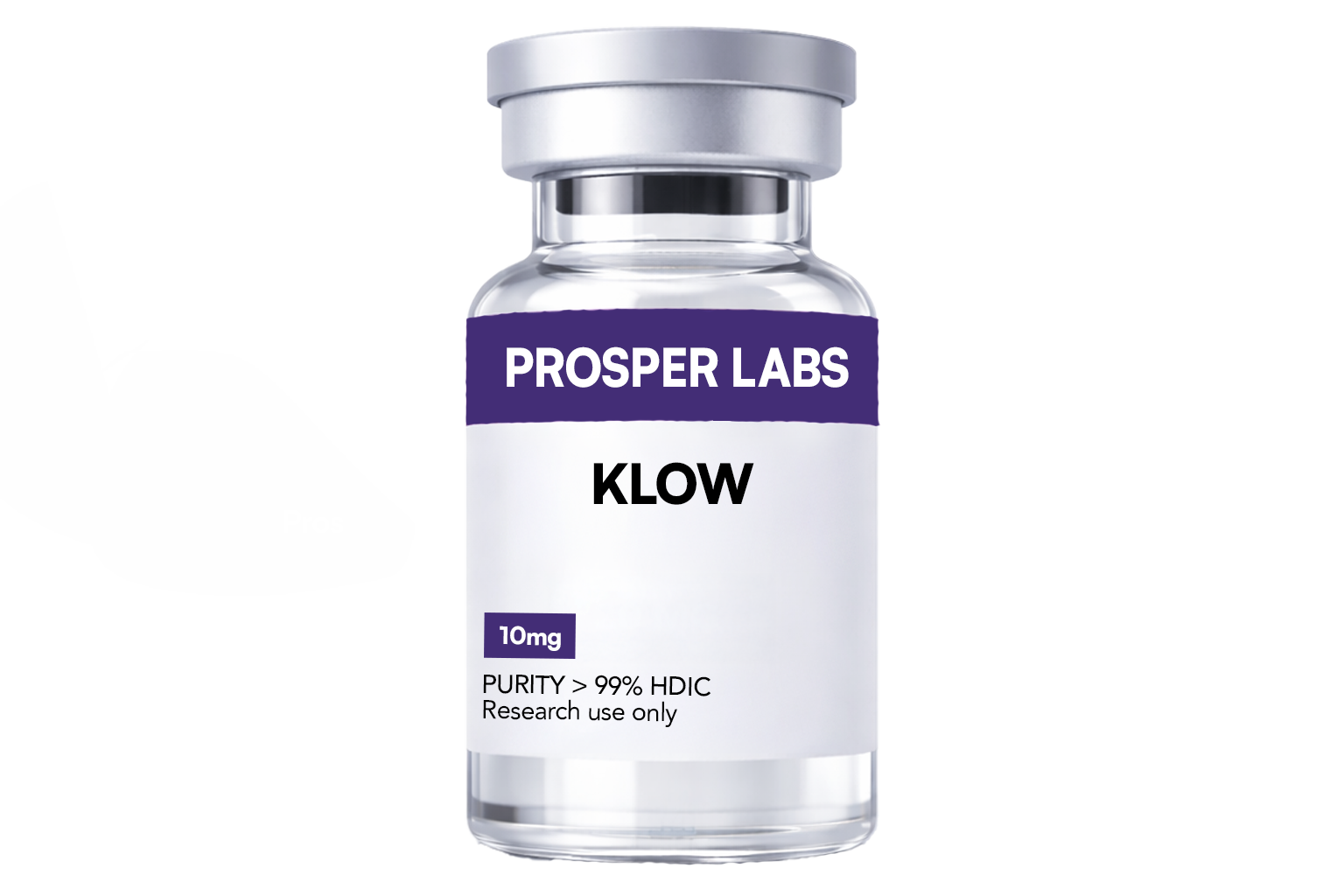
KLOW
Product Description
KLOW Multi Peptide Research Blend – 80MG (10mg BPC 157 + 10mg TB 500 + 10mg KPV + 50mg GHK Cu) Research Use Only
What it is
KLOW is a brand style name used in the research peptide market to describe a multi peptide blend rather than a single standardized molecule. Most listings describe KLOW as a combined formulation containing BPC 157, TB 500, KPV, and GHK Cu in one vial for laboratory research where multiple signaling pathways are studied together. (peptidesciences.com)
Origins and development
KLOW is not a drug code name from a pharmaceutical developer. It is a commercial blend concept built around four well known research peptides that are commonly studied individually in tissue repair models, inflammatory signaling models, and extracellular matrix biology. The blend format is used to explore multi pathway interactions in one experimental design, but each component still has its own separate research literature and limitations.
Molecular profile
Because KLOW is a blend, it does not have a single molecular formula or molecular weight. Instead, the molecular identity is defined by the four components and their amounts per vial. One common composition listed by vendors is total 80 mg made up of GHK Cu 50 mg, BPC 157 10 mg, TB 500 10 mg, and KPV 10 mg. (peptidesciences.com)
Scientific overview
KLOW is typically described as a combination of peptides that map to distinct research themes.
• BPC 157 is a 15 amino acid gastric derived peptide studied largely in preclinical tissue and organ protection models. (mdpi.com)
• TB 500 is used as a research name for thymosin beta 4 related fragments or analog concepts, commonly discussed in actin and cytoskeletal biology and tissue remodeling research contexts. (pmc.ncbi.nlm.nih.gov)
• KPV is a tripeptide motif associated with alpha melanocyte stimulating hormone derived fragments studied in inflammatory signaling models. (jpet.aspetjournals.org)
• GHK Cu is a copper binding tripeptide complex studied in skin and extracellular matrix research and broader regenerative biology discussions. (pubmed.ncbi.nlm.nih.gov)
Overall, the scientific idea of a blend is to investigate whether combining compounds that touch different signaling systems produces additive or interacting effects in a controlled model. Any conclusions depend heavily on experimental design, controls, and independent verification of identity and purity for each component.
What researchers study with KLOW
Common research focus areas include
• Multi pathway models of tissue remodeling, extracellular matrix signaling, and cellular stress responses
• Comparative studies of single compound versus blended condition signaling outcomes
• Exploratory work on pathway cross talk where cytoskeletal dynamics, inflammatory signaling, and matrix regulation may intersect
Regulatory and compliance notice
Research Use Only. Not for human or veterinary use. This description is provided for scientific context and must not be used to market this blend or any of its components for diagnosis, cure, mitigation, treatment, or prevention of disease.
Citations and references
-
Peptide Sciences. KLOW Blend listing describing the four component composition.
(peptidesciences.com) -
Józwiak M, et al. Review of BPC 157 research and proposed mechanisms across preclinical models. Pharmaceuticals (2025).
(mdpi.com) -
Maar K. Review discussing thymosin beta 4 biology and regenerative research directions. International Journal of Molecular Sciences (2021).
(pmc.ncbi.nlm.nih.gov) -
Getting SJ, et al. Study analyzing anti inflammatory effects of alpha MSH 11 to 13, KPV, in an experimental inflammation model. Journal of Pharmacology and Experimental Therapeutics (2003).
(jpet.aspetjournals.org) -
Pickart L. Review on regenerative and protective actions of the GHK Cu peptide. International Journal of Molecular Sciences (2018) indexed in PubMed.
(pubmed.ncbi.nlm.nih.gov)
COA Testing
The Certificate of Analysis for this product is shown directly below for easier review.
Certificate of Analysis coming soon
COA will display here once attached.