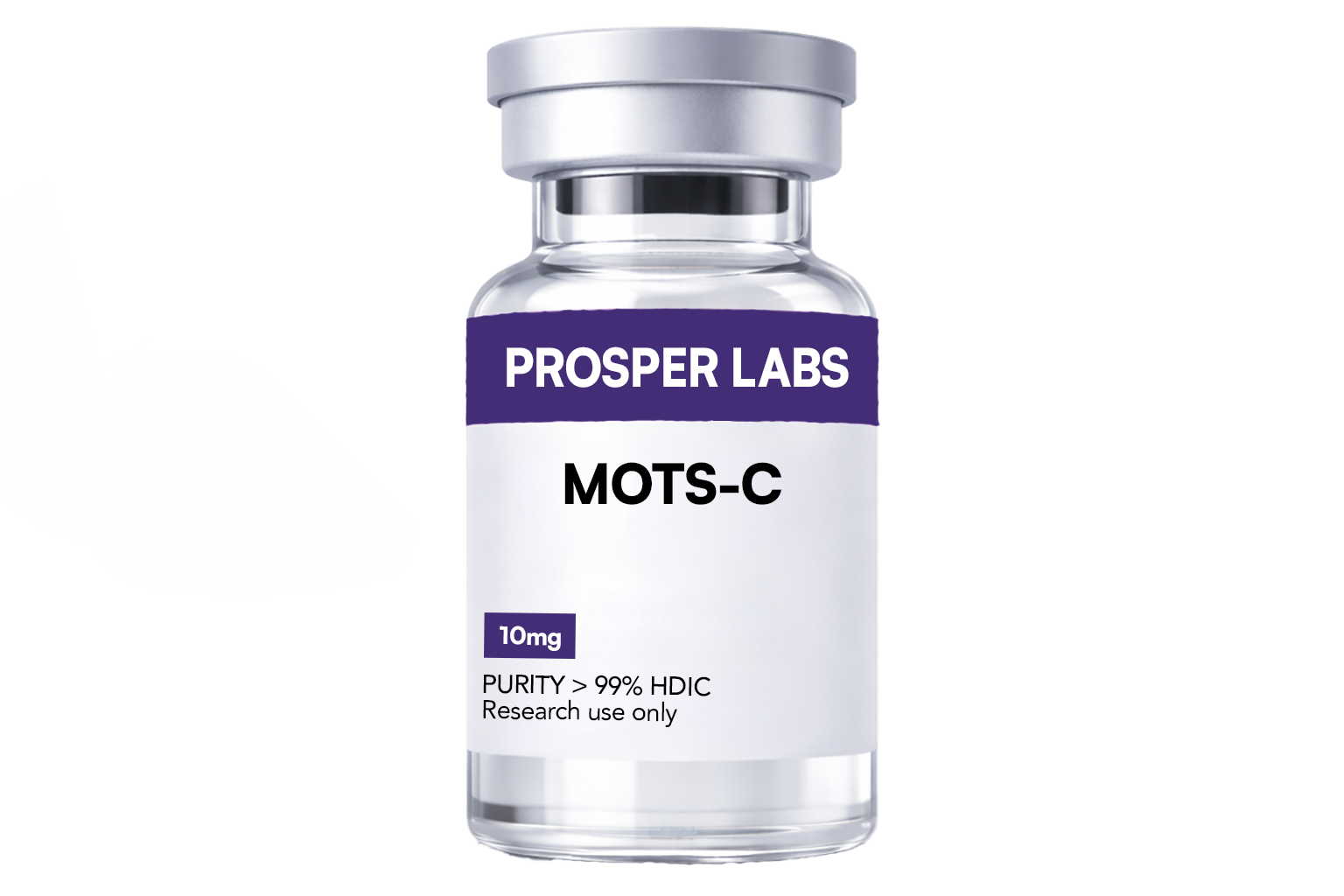
MOTS-C
Product Description
MOTS C Mitochondrial Derived Peptide | Research Use Only
What it is
MOTS C is a mitochondrial derived micropeptide composed of 16 amino acids that is encoded within the 12S rRNA region of mitochondrial DNA. It is studied as a signaling peptide involved in cellular bioenergetic homeostasis and metabolic stress responses, with research describing stress linked translocation and downstream effects on nuclear gene programs. (pubmed.ncbi.nlm.nih.gov) (pubmed.ncbi.nlm.nih.gov)
Origins and discovery
MOTS C was first reported in 2015 by Lee and colleagues, who identified a short open reading frame within mitochondrial 12S rRNA that encodes a 16 amino acid peptide and described metabolic regulation effects in experimental models. Later work expanded mechanistic understanding, including evidence that MOTS C can translocate to the nucleus during metabolic stress and influence nuclear gene expression in an AMPK dependent manner. (pubmed.ncbi.nlm.nih.gov) (pubmed.ncbi.nlm.nih.gov)
Molecular profile
PubChem lists MOTS C with molecular formula C101H152N28O22S2 and molecular weight 2174.6 g per mol. (pubchem.ncbi.nlm.nih.gov)
A commonly cited amino acid sequence for MOTS C is MRWQEMGYIFYPRKLR. (pubmed.ncbi.nlm.nih.gov) (pmc.ncbi.nlm.nih.gov)
Scientific overview
MOTS C is discussed in the literature as part of the broader family of mitochondrial derived peptides that act as communication signals between mitochondria and the rest of the cell. Reviews describe that MOTS C can be detected in tissues and circulation and that reported levels may decline with age in some contexts, while mechanistic studies link MOTS C to metabolic stress signaling and AMPK related pathways. The field remains active and many claims are still being refined as more human data and standardized measurement methods emerge. (pmc.ncbi.nlm.nih.gov) (pubmed.ncbi.nlm.nih.gov)
Clinical research
MOTS C is not an FDA approved drug. Human research has largely focused on biomarker and physiology observations, including studies measuring circulating MOTS C in specific populations and changes in response to interventions such as structured exercise programs, rather than large therapeutic trials. (pmc.ncbi.nlm.nih.gov) (pmc.ncbi.nlm.nih.gov)
What researchers study with MOTS C
Key research focus areas often include
• Mitochondria to nucleus signaling under metabolic stress and nuclear gene expression changes (pubmed.ncbi.nlm.nih.gov)
• Metabolic regulation mechanisms described in discovery and follow up studies, including AMPK related hypotheses (pubmed.ncbi.nlm.nih.gov)
• Circulating MOTS C as a physiology marker in humans, including exercise related changes reported in specific cohorts (pmc.ncbi.nlm.nih.gov)
Regulatory and compliance notice
Research Use Only. Not for human or veterinary use. This information is provided for scientific context and must not be used to market MOTS C for diagnosis, cure, mitigation, treatment, or prevention of any disease.
Citations and references
-
Lee C, et al. The mitochondrial derived peptide MOTS C promotes metabolic homeostasis and insulin sensitivity. Cell Metabolism (2015) indexed in PubMed.
(pubmed.ncbi.nlm.nih.gov) -
Kim KH, et al. MOTS C translocates to the nucleus during metabolic stress and regulates nuclear gene expression in an AMPK dependent manner. Cell Metabolism (2018) indexed in PubMed.
(pubmed.ncbi.nlm.nih.gov) -
PubChem. MOTS C compound record, includes molecular formula and molecular weight.
(pubchem.ncbi.nlm.nih.gov) -
Zheng Y, et al. MOTS C review describing 16 amino acid origin in mitochondrial 12S rRNA and broader physiology context. (2023).
(pmc.ncbi.nlm.nih.gov) -
Dieli Conwright CM, et al. Human study reporting changes in circulating MOTS C with aerobic and resistance exercise in breast cancer survivors. Scientific Reports (2021).
(pmc.ncbi.nlm.nih.gov)
COA Testing
The Certificate of Analysis for this product is shown directly below for easier review.
Certificate of Analysis coming soon
COA will display here once attached.