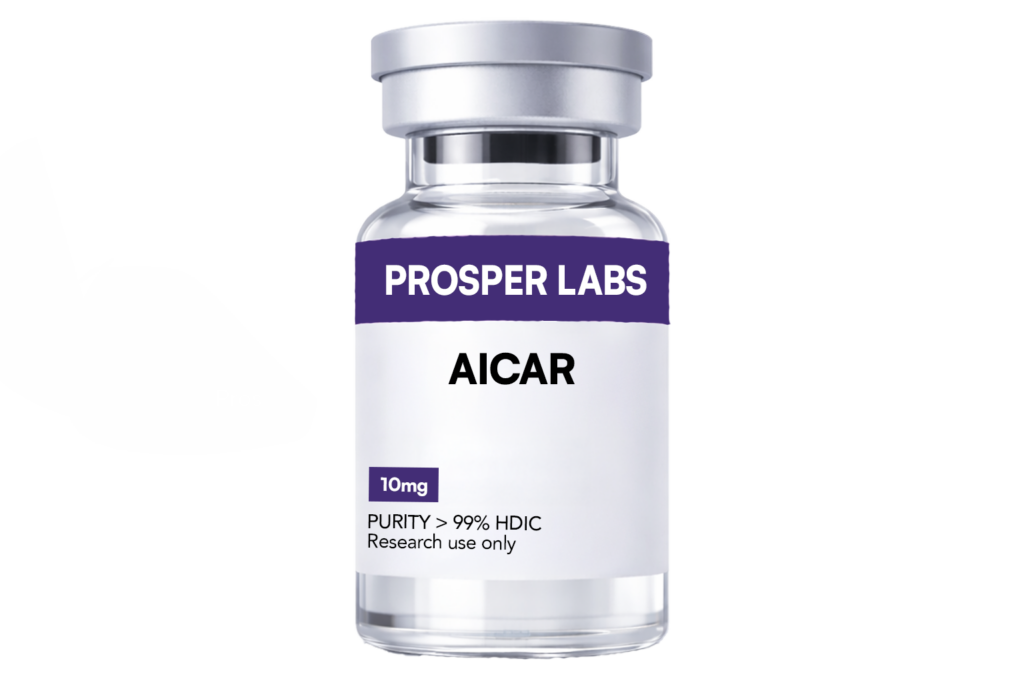
AICAR
For research / laboratory use only. Not for human consumption.
Product Description
AICAR | Research Use Only
What it is
AICAR, commonly referred to in research as 5-aminoimidazole-4-carboxamide ribonucleotide or AICA ribotide, is a nucleotide analog and metabolic intermediate studied primarily for its ability to activate AMP-activated protein kinase, or AMPK, after intracellular conversion and accumulation as ZMP-like signaling species. Because AMPK is a central cellular energy sensor, AICAR appears in research involving metabolism, mitochondrial function, glucose handling, inflammation, and exercise-mimetic biology. Sources: PubChem AICA Ribotide, Systematic review on AICAr and AMPK, AMPK exercise-mimetic study.
Origins and scientific context
AICAR has long been used as a research tool in cellular metabolism and AMPK signaling studies. Scientific reviews note that AICAr enters cells through adenosine transporters and is phosphorylated intracellularly to AICAR, where it can mimic aspects of AMP signaling and activate AMPK, although it also has important AMPK-independent effects. This is why modern literature often treats AICAR as a useful but imperfect experimental probe rather than a purely selective AMPK activator. Sources: Systematic review on AICAr and AMPK-independent effects, AMPK as a drug target review.
Molecular profile
PubChem lists AICA Ribotide with molecular formula C9H15N4O8P and molecular weight 338.21 g/mol. In the literature, AICAR-related naming can be confusing because some papers use AICAr for the riboside precursor and AICAR or ZMP for the phosphorylated intracellular nucleotide form, so researchers often distinguish carefully between the administered compound and the intracellular metabolite being studied. Sources: PubChem AICA Ribotide, Systematic review on AICAr nomenclature and mechanism.
Scientific overview
AICAR is studied because it can activate AMPK-linked pathways involved in energy homeostasis. Research has examined its effects in models of skeletal muscle adaptation, endurance signaling, mitochondrial biogenesis, neurobiology, and inflammatory injury. A widely cited mouse study reported that the AMP-mimetic AICAR increased endurance in sedentary mice through metabolic reprogramming, helping establish its reputation as an “exercise mimetic” in preclinical research. At the same time, reviews emphasize that AICAR can produce multiple off-target or AMPK-independent effects, so experimental interpretation requires caution. Sources: Exercise mimetics study, Systematic review on AICAr, Brain function study.
What researchers study with AICAR
Common research focus areas include
• AMPK activation and cellular energy sensing
• Glucose and lipid metabolism models
• Skeletal muscle adaptation and exercise-mimetic signaling
• Mitochondrial biology and endurance-related pathways
• Neurobiology and inflammatory or oxidative stress models
Sources: Systematic review on AICAr, Exercise mimetics study, Brain function study, Pulmonary injury review, Recent preclinical neuropathy study.
Regulatory and compliance notice
Research Use Only. Not for human or veterinary use. AICAR is widely discussed in the research literature, but that does not make it an approved consumer or therapeutic product for general use. FDA warning-letter activity in the broader research-compound space also makes clear that “research use only” labeling does not override evidence suggesting intended human drug use. Sources: FDA warning letter — Summit Research Peptides, FDA warning letter — Xcel Research.
Citations and references
PubChem. AICA Ribotide compound record, including molecular formula and molecular weight.
https://pubchem.ncbi.nlm.nih.gov/compound/AICA-Ribotide
Višnjić D, et al. AICAr, a Widely Used AMPK Activator with Important AMPK-Independent Effects: A Systematic Review. Review covering nomenclature, cell entry, phosphorylation, AMPK activation, and non-AMPK effects.
https://pmc.ncbi.nlm.nih.gov/articles/PMC8147799/
Narkar VA, et al. AMPK and PPARδ agonists are exercise mimetics. Widely cited preclinical paper describing AICAR as an AMP-mimetic that increased endurance in sedentary mice.
https://pmc.ncbi.nlm.nih.gov/articles/PMC2706130/
Guerrieri D, et al. Exercise-mimetic AICAR transiently benefits brain function. Preclinical study examining muscle AMPK activation and brain-related outcomes after AICAR administration.
https://pmc.ncbi.nlm.nih.gov/articles/PMC4621892/
Kong L, et al. AICAR, an AMP-Activated Protein Kinase Activator, in Acute Lung Injury Research. Review discussing AICAR in inflammatory and oxidative stress-related models.
https://pmc.ncbi.nlm.nih.gov/articles/PMC8438129/
Chandrasekaran K, et al. Administration of AICAR, an AMPK Activator, Prevents and Reverses Diabetic Peripheral Neuropathy in Mice. Recent preclinical paper examining AICAR in neuropathy-related metabolic research.
https://pmc.ncbi.nlm.nih.gov/articles/PMC11720447/
Srivastava RAK, et al. AMP-activated protein kinase: an emerging drug target to regulate imbalances in lipid and carbohydrate metabolism to treat cardio-metabolic diseases. Broader AMPK review for scientific context.
https://pmc.ncbi.nlm.nih.gov/articles/PMC3494254/
FDA. Summit Research Peptides Warning Letter — discusses how “research use only” labeling does not control intended-use analysis.
https://www.fda.gov/inspections-compliance-enforcement-and-criminal-investigations/warning-letters/summit-research-peptides-695607-12102024
FDA. Xcel Research LLC Warning Letter — additional FDA enforcement context for research-compound marketing.
https://www.fda.gov/inspections-compliance-enforcement-and-criminal-investigations/warning-letters/xcel-research-llc-694608-12102024
Storage & Handling
Store in a cool, dry place away from direct light.
COA / Testing
Certificate of Analysis coming soon. Every batch is third-party tested at >99% HPLC purity.
Shipping
Same-day shipping on orders placed before 12:00 PM PST · 2–3 day delivery via USPS Priority. Discreet packaging.