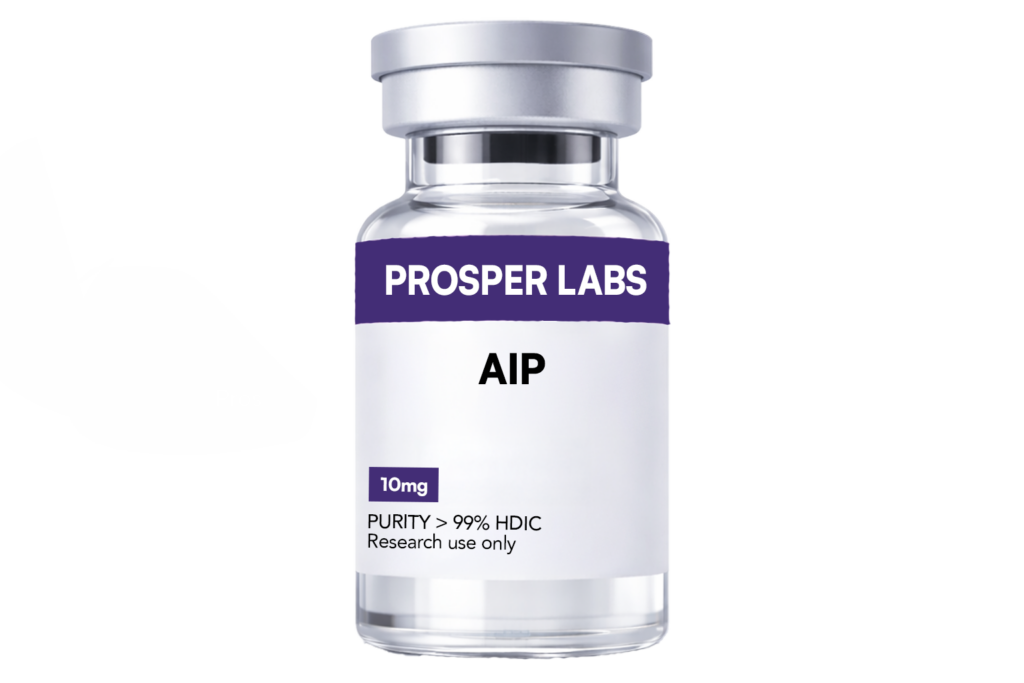
AIP
For research / laboratory use only. Not for human consumption.
Product Description
AIP | Research Use Only
What it is
AIP, short for Autocamtide-2-Related Inhibitory Peptide, is a synthetic research peptide studied primarily as a selective inhibitor of calmodulin-dependent protein kinase II (CaMKII). In the literature, it is described as a potent peptide inhibitor derived from autocamtide-related sequences and used to block CaMKII activity in biochemical, cellular, and neurophysiology research. Sources: Tocris AIP, Ishida et al. 1995, R&D Systems AIP.
Origins and scientific context
AIP emerged from efforts to develop a highly specific peptide inhibitor for CaMKII by modifying autocamtide-2, a known CaMKII substrate peptide. The classic 1995 paper describes AIP as a nonphosphorylatable analog of autocamtide-2 that showed high potency and specificity against CaMKII, helping establish it as a research tool for studying calcium-signaling pathways, kinase regulation, and downstream neuronal or cardiac signaling effects. Sources: Ishida et al. 1995, Frontiers review on CaMKII inhibitors, Cell Reports review on CaMKII tools.
Molecular profile
AIP is described in commercial and research listings as a defined synthetic peptide rather than a peptide mixture. Sequence and molecular details can vary slightly depending on the exact analog being referenced. For example, one commonly sold AIP analog, [Lys3, Phe10, Tyr13]-Autocamtide-2-Related Inhibitory Peptide, is listed with molecular weight 1652.93 and formula C74H121N23O20, while related AIP-type inhibitor listings also appear under names such as [Ala9]-Autocamtide-2. Sources: Peptide.com AIP analog, Peptide.com Ala9-Autocamtide-2, Sigma Aldrich AIP.
Scientific overview
AIP is studied because CaMKII is a major signaling kinase involved in calcium-dependent regulation of neuronal plasticity, cardiac excitability, and other cellular processes. Published work describes AIP as a highly potent and specific substrate-competitive CaMKII inhibitor, with one supplier listing an IC50 of 40 nM and the original paper reporting stronger potency than older comparator inhibitors under the assay conditions used. Because of this specificity, AIP has become a common tool in research on synaptic signaling, cardiac electrophysiology, and kinase-pathway dissection. Sources: Ishida et al. 1995, Tocris AIP, Circulation Research example.
What researchers study with AIP
Common research focus areas include
• CaMKII signaling and kinase regulation
• Calcium-dependent neuronal plasticity models
• Cardiac electrophysiology and arrhythmia-related signaling
• Synaptic transmission and receptor modulation studies
• Comparative testing versus other CaMKII inhibitors and peptide tools
Sources: Cell Reports review on CaMKII tools, Nature neuropsychopharmacology paper using AIP, Circulation Research example.
Regulatory and compliance notice
Research Use Only. Not for human or veterinary use. AIP is sold and discussed as a laboratory research peptide, and supplier listings consistently identify it for research applications rather than approved therapeutic use. The existence of research product pages and biochemical literature does not mean FDA approval for human use. Sources: Tocris AIP, MedChemExpress AIP, PeptidePharma AIP analog.
Citations and references
Ishida A, et al. A Novel Highly Specific and Potent Inhibitor of Calmodulin-Dependent Protein Kinase II.Foundational paper describing AIP as a nonphosphorylatable autocamtide-2 analog and potent CaMKII inhibitor.
https://pubmed.ncbi.nlm.nih.gov/7626114/
Tocris. Autocamtide-2-related inhibitory peptide. Supplier page describing AIP as a selective and potent CaMKII inhibitor with IC50 40 nM.
https://www.tocris.com/products/autocamtide-2-related-inhibitory-peptide_1688
R&D Systems. Autocamtide-2-related inhibitory peptide. Research product page describing AIP as a selective CaMKII inhibitor.
https://www.rndsystems.com/products/autocamtide-2-related-inhibitory-peptide_1688
Peptide.com. [Lys3, Phe10, Tyr13]-Autocamtide-2-Related Inhibitory Peptide (AIP) Analog. Sequence and molecular data for a commonly sold AIP analog.
https://www.peptide.com/product/lys3-phe10-tyr13-autocamtide-2-related-inhibitory-peptide-aip-analog/
Peptide.com. [Ala9]-Autocamtide-2. Related AIP naming and analog context.
https://www.peptide.com/product/ala9-autocamtide-2-167114-91-2/
Sigma Aldrich. Autocamtide-2 Related Inhibitory Peptide. Alternate naming and research-use context.
https://www.sigmaaldrich.com/US/en/product/mm/189480m
Brown CN, et al. Studying CaMKII: Tools and standards. Review discussing peptide inhibitors such as AIP in CaMKII research.
https://www.cell.com/cell-reports/fulltext/S2211-1247%2824%2900310-3
Pellicena P, Schulman H. CaMKII inhibitors: from research tools to therapeutic agents. Review discussing current CaMKII inhibitors and research tools including peptide inhibitors.
https://www.frontiersin.org/journals/pharmacology/articles/10.3389/fphar.2014.00021/full
Shen G, et al. Calcium/Calmodulin-Dependent Protein Kinase II Mediates… Example of AIP use in neuronal signaling research.
https://www.nature.com/articles/npp201061
Xie LH, et al. Induced Afterdepolarizations and Calmodulin Kinase II… Example of AIP use in cardiac electrophysiology research.
https://www.ahajournals.org/doi/pdf/10.1161/circresaha.108.183475
Storage & Handling
Store in a cool, dry place away from direct light.
COA / Testing
Certificate of Analysis coming soon. Every batch is third-party tested at >99% HPLC purity.
Shipping
Same-day shipping on orders placed before 12:00 PM PST · 2–3 day delivery via USPS Priority. Discreet packaging.