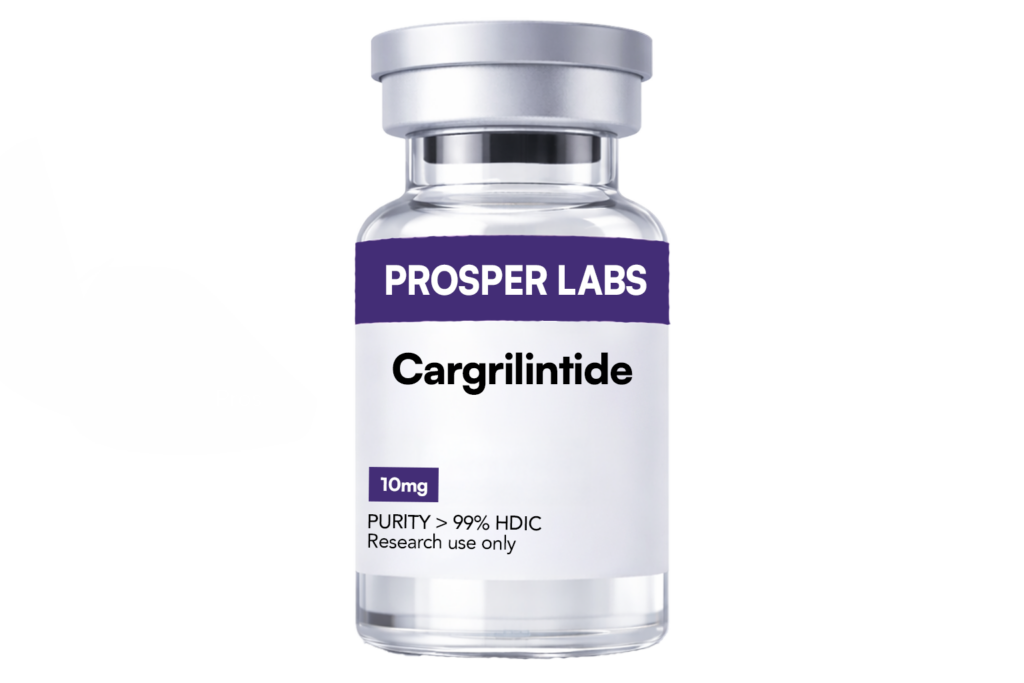
Cargrilintide
For research / laboratory use only. Not for human consumption.
Product Description
Cagrilintide | Research Use Only
What it is
Cagrilintide is a long-acting peptide analogue of amylin studied primarily for its effects on appetite regulation, body weight, and metabolic signaling. In the literature, it is described as an investigational amylin receptor agonist with additional activity at calcitonin-family receptor complexes, which is why it appears in obesity and type 2 diabetes research. Sources: PubChem Cagrilintide, Carvas et al. 2025, Cao et al. 2025.
Origins and scientific context
Cagrilintide was developed as a more stable, longer-acting amylin analogue for once-weekly administration. Reviews describe it as part of a newer wave of amylin-based obesity therapeutics intended to improve upon earlier agents by enhancing pharmacokinetics and receptor activity while supporting clinically meaningful weight reduction. It is frequently discussed both as a stand-alone investigational therapy and as part of combination strategies with semaglutide. Sources: Amylin review 2025, Amylin review 2026, Novo Nordisk pipeline.
Molecular profile
PubChem lists cagrilintide with molecular formula C194H312N54O59S2 and molecular weight 4409 g/mol. PubChem also lists an acetate-associated entry separately, which is why some laboratory references may show slightly different naming depending on the form being discussed. Sources: PubChem Cagrilintide, PubChem Cagrilintide acetate.
Scientific overview
Cagrilintide is studied because amylin signaling influences satiety, gastric emptying, glucagon regulation, and energy balance. Clinical and translational papers describe cagrilintide as producing dose-dependent weight loss in obesity studies, while mechanistic work suggests activity through brain amylin receptors and related receptor complexes. More recent structural work also describes cagrilintide as a long-acting agonist of amylin and calcitonin receptors in late-phase obesity trials. Sources: Carvas et al. 2025, Dutta et al. 2024, Cao et al. 2025.
What researchers study with Cagrilintide
Common research focus areas include
• Amylin receptor signaling and appetite regulation
• Body weight reduction and obesity treatment models
• Combination therapy research with GLP-1 receptor agonists
• Gastric emptying, satiety, and metabolic control
• Type 2 diabetes and obesity-related cardiometabolic outcomes
Sources: Carvas et al. 2025, Hales et al. 2025, Dutta et al. 2024.
Regulatory and compliance notice
Research Use Only. Not for human or veterinary use. Cagrilintide is not FDA-approved, and FDA states that retatrutide and cagrilintide cannot be used in compounding under federal law. FDA also states that these substances are not components of FDA-approved drugs and have not been found safe and effective for any condition. Novo Nordisk’s 2025 annual reporting indicates that cagrilintide’s phase 3 obesity program was initiated, but that does not mean approval. Sources: FDA GLP-1 compounding statement, Novo Nordisk Annual Report 2025, Novo Nordisk Form 20-F 2025.
Citations and references
PubChem. Cagrilintide compound record, including molecular weight and compound identifiers.
https://pubchem.ncbi.nlm.nih.gov/compound/Cagrilintide
PubChem. Cagrilintide (acetate) record, including alternate form and molecular formula listing.
https://pubchem.ncbi.nlm.nih.gov/compound/164618153
Carvas AO, et al. Cagrilintide lowers bodyweight through brain amylin receptors and regulates hypothalamic and hindbrain pathways in mice. Discusses cagrilintide as a long-acting stable amylin analogue under investigation for obesity and type 2 diabetes.
https://pmc.ncbi.nlm.nih.gov/articles/PMC12270663/
Dutta D, et al. Efficacy and Safety of Cagrilintide Alone and in Combination With Semaglutide in Overweight and Obesity. Reviews clinical efficacy and safety signals for cagrilintide and CagriSema.
https://pmc.ncbi.nlm.nih.gov/articles/PMC11642503/
Volčanšek Š, et al. Amylin: From Mode of Action to Future Clinical Potential in Obesity and Type 2 Diabetes Mellitus. Review describing cagrilintide as a once-weekly long-acting amylin analogue and summarizing phase 2 obesity data.
https://pmc.ncbi.nlm.nih.gov/articles/PMC12085449/
Chung CW, et al. Amylin Revisited: A 5-Year Perspective on Its Emerging Role in Obesity Treatment. Review covering newer amylin analogues, including cagrilintide.
https://pmc.ncbi.nlm.nih.gov/articles/PMC12884623/
Cao J, et al. Structural and dynamic features of cagrilintide binding to amylin and calcitonin receptors. Mechanistic structural paper describing cagrilintide as a long-acting agonist in late-phase obesity trials.
https://pmc.ncbi.nlm.nih.gov/articles/PMC11982234/
Hales CM, et al. Expanding the Treat-to-Target Toolbox for Obesity and Type 2 Diabetes. Discusses REDEFINE trials and combination strategies involving cagrilintide.
https://pmc.ncbi.nlm.nih.gov/articles/PMC12501999/
FDA. FDA’s Concerns with Unapproved GLP-1 Drugs Used for Weight Loss. States that retatrutide and cagrilintide cannot be used in compounding under federal law and are not components of FDA-approved drugs.
https://www.fda.gov/drugs/postmarket-drug-safety-information-patients-and-providers/fdas-concerns-unapproved-glp-1-drugs-used-weight-loss
Novo Nordisk. Annual Report 2025. Notes that the phase 3 program with cagrilintide was initiated.
https://www.novonordisk.com/content/dam/nncorp/global/en/investors/irmaterial/annual_report/2026/novo-nordisk-annual-report-2025.pdf
Novo Nordisk. Form 20-F 2025. Lists cagrilintide for obesity with phase 3 initiated in 2025.
https://www.novonordisk.com/content/dam/nncorp/global/en/investors/irmaterial/annual_report/2026/novo-nordisk-form-20-f-2025.pdf
Storage & Handling
Store in a cool, dry place away from direct light.
COA / Testing
Certificate of Analysis coming soon. Every batch is third-party tested at >99% HPLC purity.
Shipping
Same-day shipping on orders placed before 12:00 PM PST · 2–3 day delivery via USPS Priority. Discreet packaging.