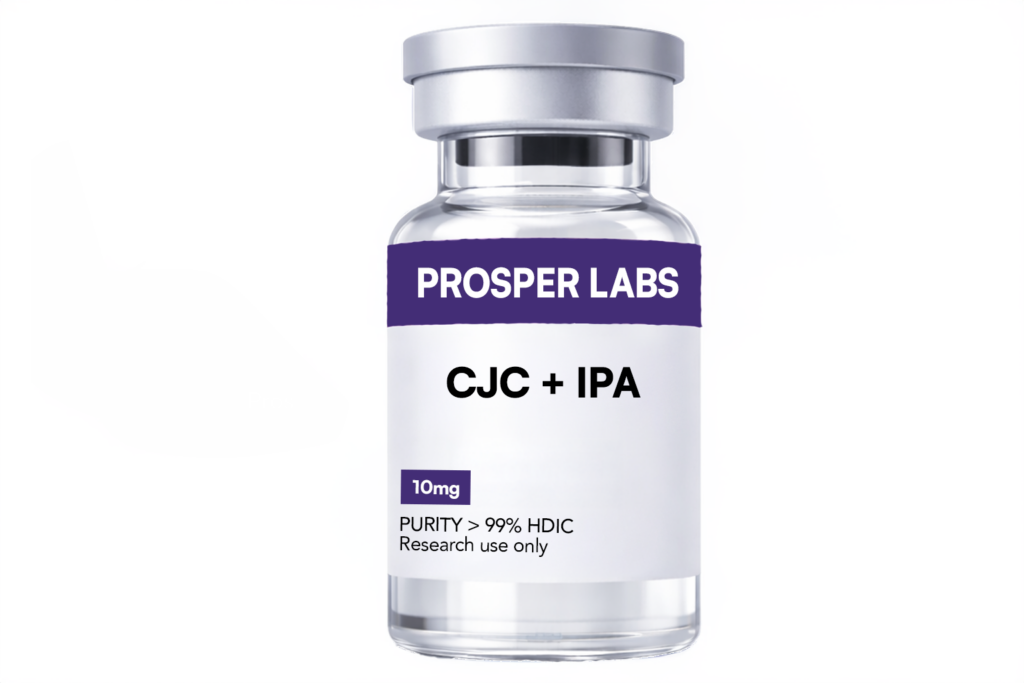
CJC 1295 Without Dac 5mg + IPA 5mg
For research / laboratory use only. Not for human consumption.
Product Description
CJC-1295 Without DAC 5 mg + Ipamorelin 5 mg | Research Use Only
What it is
CJC-1295 without DAC + Ipamorelin is a combination of two synthetic growth-hormone-axis research peptides that are often paired in laboratory contexts because they act through different signaling pathways. CJC-1295 without DAC is commonly discussed as a short, modified growth hormone-releasing hormone analog related to GRF(1-29), while Ipamorelin is a selective pentapeptide growth hormone secretagogue that acts through the ghrelin receptor pathway.
Origins and development
CJC-1295 was developed as a modified hGRF(1-29) analog designed to improve stability and prolong biological activity relative to native short GHRH fragments. In the original development literature, CJC-1295 itself refers to the long-acting analog with an added drug-affinity complex component, while “CJC-1295 without DAC” is commonly used in commercial and research settings to describe the shorter modified GRF(1-29)-type version that does not include that albumin-binding extension. Ipamorelin was developed separately as a selective growth hormone secretagogue and ghrelin receptor agonist.
Molecular profile
PubChem lists CJC-1295 without DAC with a computed molecular weight of 3367.9 g/mol. PubChem lists Ipamorelinwith a computed molecular weight of 711.9 g/mol, and also lists Ipamorelin acetate separately because salt forms alter mass and formula while remaining related to the same active peptide identity. For context, the parent short GHRH fragment sermorelin is listed separately by PubChem with a molecular weight of 3357.9 g/mol, which helps illustrate how close CJC-1295 without DAC is to modified GRF(1-29)-type structures derived from GHRH(1-29).
Scientific overview
In simplified terms, this combination is discussed in research because the two components stimulate the GH axis through different receptor systems. CJC-1295 without DAC is tied to the GHRH receptor side of the pathway, whereas Ipamorelin is tied to the ghrelin / GHS-R1a receptor side. Researchers use this kind of pairing to study pulsatile hormone signaling, receptor cross-talk, downstream IGF-1 biology, and how separate secretagogue pathways interact under controlled conditions. Outcomes depend heavily on model design, exposure conditions, formulation identity, and analytical verification of the material being studied.
Clinical research
Neither CJC-1295 without DAC nor Ipamorelin is an FDA-approved drug product. Human clinical work has been published for CJC-1295 as the long-acting GHRH analog, including studies reporting sustained GH and IGF-1 increases in healthy adults, but those studies were on CJC-1295 as developed in the literature, not proof of safety or efficacy for products marketed as “CJC-1295 without DAC + Ipamorelin” research combinations. FDA materials also state there are no FDA-approved drug products containing Ipamorelin and discuss limited available clinical safety information for compounded versions.
What researchers study with CJC-1295 without DAC + Ipamorelin
Key research focus areas often include
• GH-axis signaling and receptor interplay, including GHRH-receptor and ghrelin-receptor pathway interaction models.
• Comparative stability and analog design, especially how modified GRF-type peptides differ from native hGRF(1-29) or longer-acting DAC-containing analogs.
• Secretagogue pharmacology, including selective ghrelin-receptor agonism and downstream endocrine readouts in controlled systems.
• Analytical identity, purity, and impurity profiling, which is especially important for synthetic peptides and compounded peptide materials.
• Regulatory and anti-doping context, since both GHRH analogs and growth hormone secretagogues are treated as prohibited performance-enhancing substances in sport.
Regulatory and compliance notice
Research Use Only. Not for human or veterinary use. FDA has stated that compounded drug products containing CJC-1295 may present safety risks, including immunogenicity concerns and reported serious adverse events, and that compounded Ipamorelin acetate may also present safety risks and peptide characterization complexities. In sport, WADA’s 2026 Prohibited List includes growth hormone-releasing hormone analogs and growth hormone secretagogues and their mimetics, with Ipamorelin specifically named as an example. This is not a statement of clinical approval, safety, or efficacy.
Citations and references
PubChem. CJC1295 Without DAC compound record, including molecular weight and identifiers.
PubChem. Ipamorelin compound record, including molecular weight and identifiers.
PubChem. Ipamorelin acetate record, showing separate salt-form listing.
PubChem. Sermorelin compound record, useful parent-fragment comparison for GRF(1-29)-derived analogs.
Jetté L, et al. Human growth hormone-releasing factor (hGRF)1-29-albumin bioconjugates activate the GRF receptor on the anterior pituitary in rats: identification of CJC-1295 as a long-lasting GRF analog. Endocrinology. 2005.
Teichman SL, et al. Prolonged stimulation of growth hormone (GH) and insulin-like growth factor I secretion by CJC-1295, a long-acting analog of GH-releasing hormone, in healthy adults. J Clin Endocrinol Metab. 2006.
Raun K, et al. Ipamorelin, the first selective growth hormone secretagogue. Eur J Endocrinol. 1998.
Johansen PB, et al. Ipamorelin, a new growth-hormone-releasing peptide. J Endocrinol. 1999.
FDA. Bulk drug substances and compounding safety materials discussing CJC-1295 and Ipamorelin-related substances.
WADA. 2026 Prohibited List and related notice confirming growth hormone secretagogues and related substances are prohibited in sport.
Storage & Handling
Store in a cool, dry place away from direct light.
COA / Testing
Independently verified — purity by HPLC and endotoxin by LAL (USP <85>). The full reports are shown below.
Jump to COA & EndotoxinShipping
Same-day shipping on orders placed before 12:00 PM PST · 2–3 day delivery via USPS Priority. Discreet packaging.
Third-Party Tested
Every batch is independently verified by Freedom Diagnostics — purity by HPLC and endotoxin by the LAL assay (USP <85>). Both certificates are shown in full below.