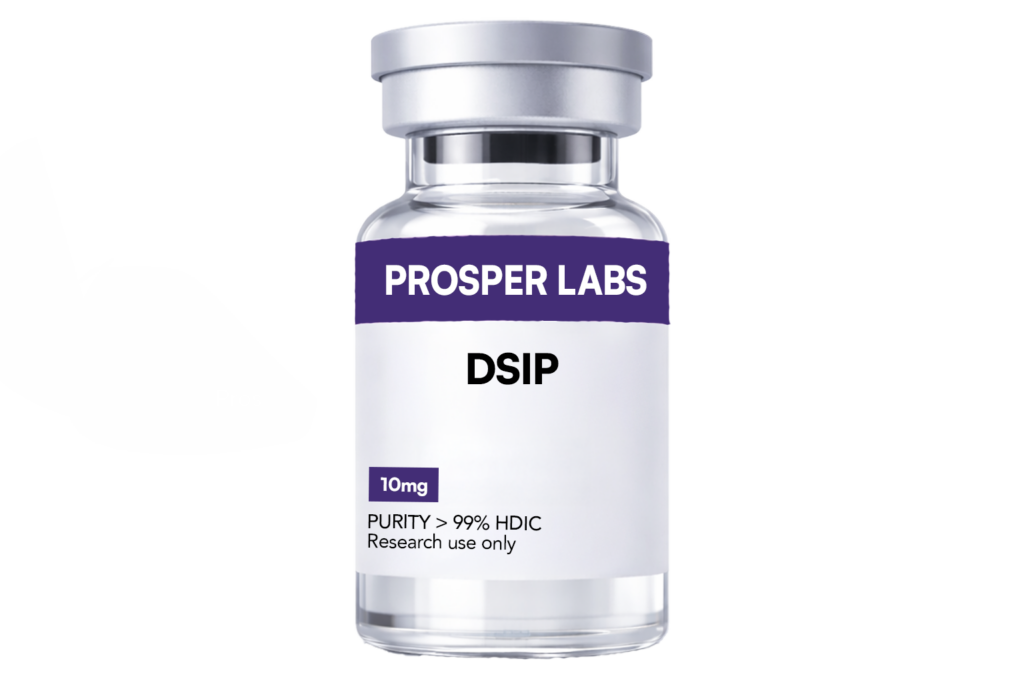
DSIP
For research / laboratory use only. Not for human consumption.
Product Description
DSIP | Research Use Only
What it is
DSIP, short for delta sleep-inducing peptide, is a naturally described nonapeptide that was originally isolated from rabbit cerebral venous blood and investigated for possible sleep-related biological activity. In the literature, it is described as a peptide with reported effects across sleep regulation, neuroendocrine signaling, stress responses, and other CNS-related pathways, although its exact physiological role remains debated. Sources: PubChem DSIP, Graf 1984 review, Kovalzon 2006 review.
Origins and scientific context
DSIP first gained attention in the late 1970s as a candidate endogenous sleep factor after being isolated during experiments involving low-frequency stimulation of thalamic regions in rabbits. Later reviews note that although DSIP became widely studied, the hypothesis that it functions as a true endogenous sleep-promoting factor has remained unresolved because the biological evidence has been inconsistent and its natural occurrence, receptor biology, and precise mechanism have not been firmly established. Sources: Graf 1984 review, Kovalzon 2006 review, Tukhovskaya et al. 2021.
Molecular profile
DSIP is commonly described as a nonapeptide with molecular weight of about 849 Da. PubChem lists delta sleep-inducing peptide as a peptide compound record rather than a complex mixture, which makes it more comparable to a discrete research peptide than products such as Cerebrolysin. Sources: PubChem DSIP, Graf 1984 review.
Scientific overview
DSIP is studied because published work has associated it with sleep architecture, stress adaptation, endocrine effects, pain biology, and neuroprotection-related pathways. At the same time, the scientific literature repeatedly emphasizes that DSIP remains controversial: some studies report biological activity in sleep and neuroendocrine systems, while later reviews describe the sleep-factor hypothesis as weakly documented and still unresolved. More recent preclinical work continues to investigate DSIP in neurological recovery models, which shows that it remains of experimental interest even though its endogenous role is still uncertain. Sources: Kovalzon 2006 review, Iyer et al. 1988, Tukhovskaya et al. 2021.
What researchers study with DSIP
Common research focus areas include
• Sleep architecture and slow-wave sleep biology
• Neuroendocrine signaling and growth hormone-related pathways
• Stress adaptation and CNS regulatory mechanisms
• Pain modulation and neuroprotective research models
• Experimental recovery and motor-function studies after neurologic injury
Sources: Graf 1984 review, Kovalzon 2006 review, Iyer et al. 1988, Tukhovskaya et al. 2021.
Regulatory and compliance notice
Research Use Only. Not for human or veterinary use. DSIP is discussed in the scientific literature and listed in public chemical databases, but that does not mean it is FDA-approved for therapeutic use. FDA warning letters in the peptide and research-compound space also make clear that labeling a product “research use only” does not override intended-use concerns when products are marketed in ways suggesting human use. Sources: PubChem DSIP, FDA warning letter — USApeptide.com, FDA warning letter — Summit Research Peptides.
Citations and references
PubChem. Delta Sleep-Inducing Peptide compound record.
https://pubchem.ncbi.nlm.nih.gov/compound/68816
Graf MV, Kastin AJ. Delta-sleep-inducing peptide (DSIP): a review. Review describing DSIP as a nonapeptide of about 849 molecular weight and summarizing early sleep-related findings.
https://pubmed.ncbi.nlm.nih.gov/6145137/
Kovalzon VM, et al. Delta sleep-inducing peptide (DSIP): a still unresolved riddle. Review emphasizing that DSIP’s role as a true endogenous sleep factor remains poorly documented and unresolved.
https://pubmed.ncbi.nlm.nih.gov/16539679/
Iyer KS, et al. Evidence for a role of delta sleep-inducing peptide in slow-wave sleep-related growth hormone release in the rat. Experimental paper examining DSIP in sleep-related growth hormone biology.
https://pmc.ncbi.nlm.nih.gov/articles/PMC280272/
Tukhovskaya EA, et al. Delta Sleep-Inducing Peptide Recovers Motor Function in SD Rats by Regulating PSD-95.More recent preclinical study showing continuing DSIP research in neurologic recovery models.
https://pmc.ncbi.nlm.nih.gov/articles/PMC8434407/
FDA. USApeptide.com Warning Letter (Feb. 26, 2025). Example of FDA enforcement stating that research-use labeling does not prevent products from being treated as unapproved drugs when marketed for human use.
https://www.fda.gov/inspections-compliance-enforcement-and-criminal-investigations/warning-letters/usapeptidecom-696885-02262025
FDA. Summit Research Peptides Warning Letter (Dec. 10, 2024). Additional FDA enforcement context regarding research peptides and intended human use.
https://www.fda.gov/inspections-compliance-enforcement-and-criminal-investigations/warning-letters/summit-research-peptides-695607-12102024
Storage & Handling
Store in a cool, dry place away from direct light.
COA / Testing
Certificate of Analysis coming soon. Every batch is third-party tested at >99% HPLC purity.
Shipping
Same-day shipping on orders placed before 12:00 PM PST · 2–3 day delivery via USPS Priority. Discreet packaging.