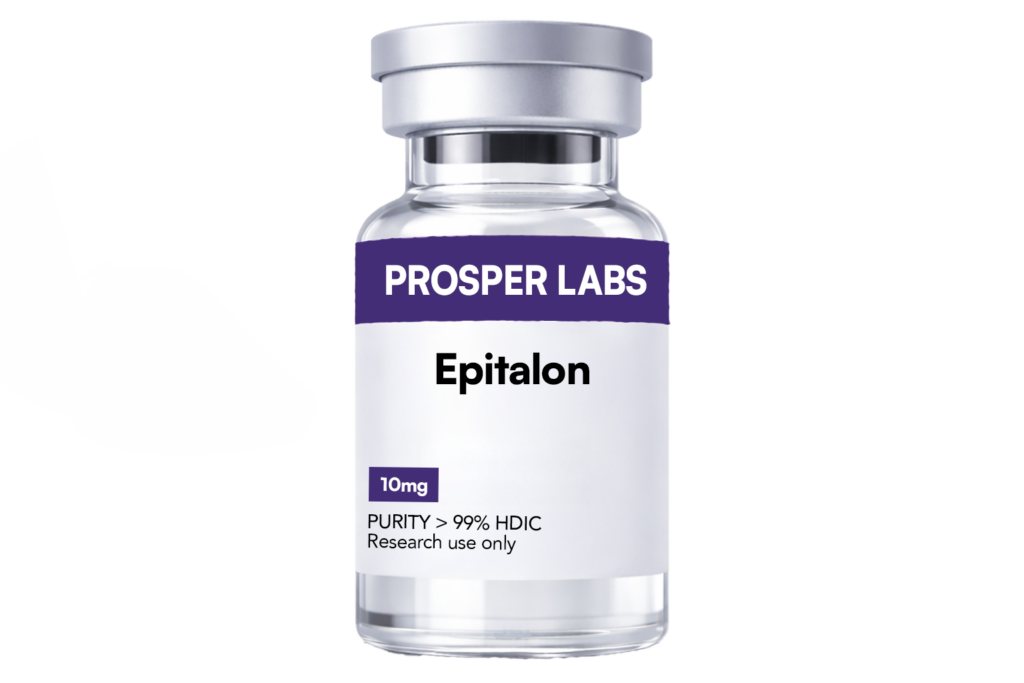
Epitalon
For research / laboratory use only. Not for human consumption.
Product Description
Epitalon | Research Use Only
What it is
Epitalon, also called epithalon or the AEDG peptide, is a synthetic tetrapeptide composed of alanine, glutamic acid, aspartic acid, and glycine. In the literature, it is described as a short peptide studied primarily in aging, telomerase, pineal signaling, and cell-regulation research, which is why it appears in discussions of longevity biology and age-related cellular function. Sources: PubChem Epitalon, Araj 2025 review, Khavinson 2020 review.
Origins and scientific context
Epitalon emerged from research on pineal peptides and bioregulators, especially work associated with epithalamin and related short peptides derived from or inspired by pineal gland signaling. Reviews describe it as part of a broader line of peptide bioregulator research focused on aging, neuroendocrine regulation, and chromatin or gene-expression effects. Modern papers still discuss Epitalon in the context of telomerase-related and geroprotective hypotheses, but the evidence base remains much stronger in preclinical and exploratory literature than in large mainstream clinical programs. Sources: Araj 2025 review, Khavinson 2020 review, Palmer 2024 review.
Molecular profile
PubChem lists Epitalon with molecular formula C14H22N4O9. Because it is a discrete tetrapeptide rather than a peptide mixture, it is described in chemical databases as a single compound and is often cross-referenced under the alternate name Epithalon. Sources: PubChem Epitalon, PubChem Epithalon substance entry.
Scientific overview
Epitalon is studied because published work has linked it to telomerase-related biology, telomere length regulation, oxidative stress pathways, pineal signaling, and broader aging-associated cellular processes. Reviews and recent experimental papers describe findings suggesting that Epitalon may influence telomerase expression or telomere dynamics in certain cell systems, but these findings remain part of an evolving research area rather than an established therapeutic consensus. More recent preclinical work continues to investigate it in aging, inflammatory regulation, wound healing, and cellular resilience models. Sources: Araj 2025 review, Al-dulaimi 2025, Gatta 2025, Khavinson 2020 review.
What researchers study with Epitalon
Common research focus areas include
• Telomerase expression and telomere biology
• Pineal peptide signaling and circadian or neuroendocrine pathways
• Cellular aging and longevity-related models
• Oxidative stress and inflammatory regulation
• Experimental tissue-repair and resilience studies
Sources: Araj 2025 review, Khavinson 2020 review, Avolio 2022, Gatta 2025.
Regulatory and compliance notice
Research Use Only. Not for human or veterinary use. Epitalon is listed in public chemical databases and discussed in the scientific literature, but that does not mean it is FDA-approved for therapeutic use. FDA also maintains that certain nominated bulk substances used in compounding may present significant safety risks, and more broadly, research-use labeling does not by itself establish lawful human use. Sources: PubChem Epitalon, FDA bulk substances safety-risk page.
Citations and references
PubChem. Epitalon compound record, including formula and identifiers.
https://pubchem.ncbi.nlm.nih.gov/compound/Epitalon
PubChem. Epithalon substance entry, showing alternate naming linked to Epitalon.
https://pubchem.ncbi.nlm.nih.gov/substance/135141173
Araj SK, et al. Overview of Epitalon—Highly Bioactive Pineal Tetrapeptide as a Geroprotector. Review covering peptide sequence, biological context, and aging-related research.
https://pmc.ncbi.nlm.nih.gov/articles/PMC11943447/
Al-dulaimi S, et al. Epitalon increases telomere length in human cell lines. Recent experimental paper discussing telomerase activity, hTERT expression, and telomere findings in cell models.
https://pmc.ncbi.nlm.nih.gov/articles/PMC12411320/
Khavinson V, et al. AEDG Peptide (Epitalon) Stimulates Gene Expression and Protein Synthesis during Neurogenesis and Promotes Neuronal Differentiation. Review and mechanistic discussion of AEDG/Epitalon biology.
https://pmc.ncbi.nlm.nih.gov/articles/PMC7037223/
Palmer RD, et al. Biomedicines in Longevity and Aging. Review discussing Epithalon as a peptide of interest in telomere and longevity research.
https://pmc.ncbi.nlm.nih.gov/articles/PMC10962562/
Gatta M, et al. The Antioxidant Tetrapeptide Epitalon Enhances Delayed Wound Healing. Recent paper discussing Epitalon in oxidative stress and repair-related research.
https://pmc.ncbi.nlm.nih.gov/articles/PMC12356729/
Avolio F, et al. Peptides Regulating Proliferative Activity and Inflammatory Cytokines in THP-1 Cells. Includes Epitalon among short peptides studied for inflammatory and proliferative signaling.
https://pmc.ncbi.nlm.nih.gov/articles/PMC8999041/
FDA. Certain Bulk Drug Substances for Use in Compounding That May Present Significant Safety Risks. FDA compounding-risk context relevant to non-approved bulk substances.
https://www.fda.gov/drugs/human-drug-compounding/certain-bulk-drug-substances-use-compounding-may-present-significant-safety-risks
Storage & Handling
Store in a cool, dry place away from direct light.
COA / Testing
Certificate of Analysis coming soon. Every batch is third-party tested at >99% HPLC purity.
Shipping
Same-day shipping on orders placed before 12:00 PM PST · 2–3 day delivery via USPS Priority. Discreet packaging.