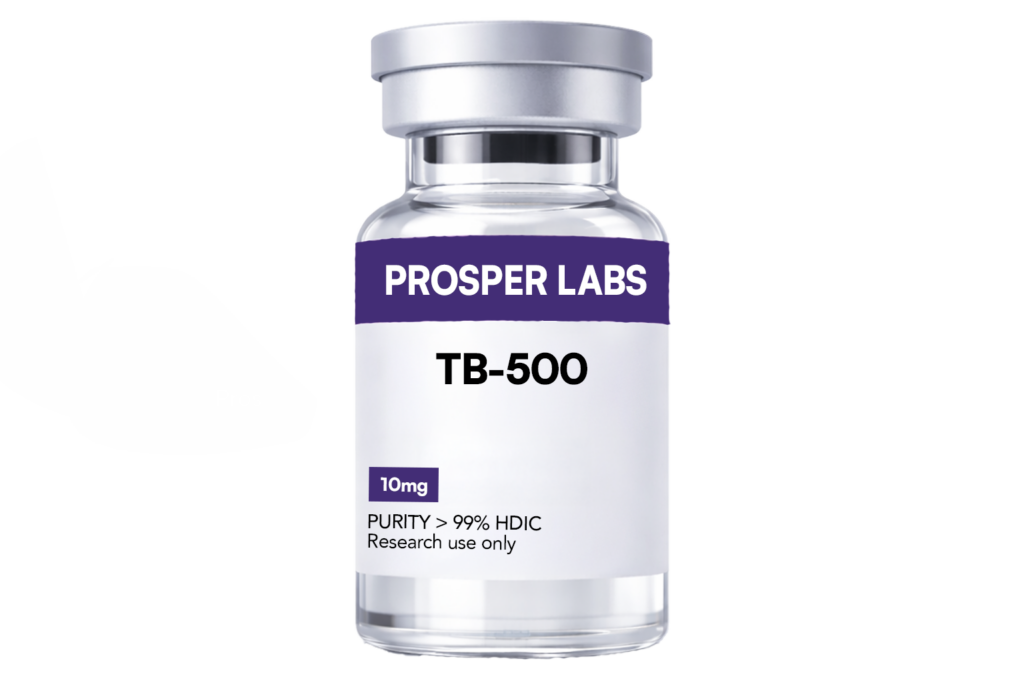
TB-500
For research / laboratory use only. Not for human consumption.
Product Description
TB 500 Thymosin Beta 4 Derived Peptide Fragment | Research Use Only
What it is
TB 500 is a synthetic peptide fragment that has been identified as the N terminal acetylated 17 to 23 fragment of human thymosin beta 4, with the sequence Ac LKKTETQ. It is discussed in research and anti doping literature because it represents a short fragment of thymosin beta 4 associated with actin related biology, and because products sold under the TB 500 name have been investigated for identity and composition. (pubmed.ncbi.nlm.nih.gov)
Origins and development
TB 500 is not a pharmaceutical code name tied to an FDA approved drug program. The name is most commonly used in commercial research peptide contexts, and a key analytical study reported that material marketed as TB 500 contained the N terminal acetylated 17 to 23 thymosin beta 4 fragment Ac LKKTETQ, confirmed using high resolution mass spectrometry methods. (pubmed.ncbi.nlm.nih.gov) (analyticalsciencejournals.onlinelibrary.wiley.com)
Molecular profile
PubChem lists a TB 500 related record under the synonym TB500 with a computed molecular weight of 889.0 g per mol. PubChem also lists a trifluoroacetic salt entry as a separate record, which is important because salt forms change molecular formula and mass while the underlying peptide identity remains conceptually tied to the same sequence. (pubchem.ncbi.nlm.nih.gov) (pubchem.ncbi.nlm.nih.gov)
For context, full length thymosin beta 4 is a 43 amino acid endogenous peptide with a PubChem listed molecular weight of 4963 g per mol, and it is also known by the International Nonproprietary Name timbetasin. (pubchem.ncbi.nlm.nih.gov) (pubchem.ncbi.nlm.nih.gov)
Scientific overview
In simplified terms, thymosin beta 4 is a well studied actin binding peptide involved in cell migration and tissue repair biology, and TB 500 is discussed as a short fragment derived from that larger peptide. Researchers often use thymosin beta 4 models to study cytoskeletal dynamics, wound repair processes, angiogenesis related readouts, and inflammatory signaling, while a short fragment like Ac LKKTETQ is used to probe whether a smaller sequence can reproduce any subset of those effects in controlled systems. Outcomes depend strongly on the model, dose exposure, and the exact identity of the material being tested. (pubmed.ncbi.nlm.nih.gov)
Clinical research
TB 500 itself is not an FDA approved drug. Human clinical trial listings exist for thymosin beta 4 in wound healing related research, but those are studies of the full length peptide, not proof of safety or efficacy for products marketed under the TB 500 name. (clinicaltrials.gov)
What researchers study with TB 500
Key research focus areas often include
• Actin and cytoskeletal dynamics and cell migration related assays, informed by thymosin beta 4 biology (pubmed.ncbi.nlm.nih.gov)
• Analytical identity testing and impurity profiling of materials sold as TB 500, including confirmation of Ac LKKTETQ by mass spectrometry (pubmed.ncbi.nlm.nih.gov)
• Translational context and regulatory constraints, including anti doping classification of thymosin beta 4 derivatives (wada-ama.org)
Regulatory and compliance notice
Research Use Only. Not for human or veterinary use. The World Anti Doping Agency prohibited list includes thymosin beta 4 and its derivatives, for example TB 500, under prohibited substances in sport, which is a useful indicator of how regulators view this class of peptides in competition contexts. This is not a statement of clinical approval or safety. (wada-ama.org)
Citations and references
-
PubChem. TB500 synonym record UNII QHK6Z47GTG, includes identifiers and molecular weight.
https://pubchem.ncbi.nlm.nih.gov/compound/Unii-qhk6Z47gtg (pubchem.ncbi.nlm.nih.gov) -
Esposito S, et al. Detection and identification of the N terminal acetylated 17 to 23 fragment of thymosin beta 4 Ac LKKTETQ in TB 500 using high resolution mass spectrometry. Drug Testing and Analysis (2012). PubMed record.
https://pubmed.ncbi.nlm.nih.gov/22962027/ (pubmed.ncbi.nlm.nih.gov)
Publisher page.
https://analyticalsciencejournals.onlinelibrary.wiley.com/doi/10.1002/dta.1402(analyticalsciencejournals.onlinelibrary.wiley.com) -
PubChem. Thymosin beta 4 compound record, includes molecular weight and identifiers.
https://pubchem.ncbi.nlm.nih.gov/compound/Thymosin-beta-4 (pubchem.ncbi.nlm.nih.gov) -
Malinda KM, et al. Thymosin beta 4 accelerates wound healing in a rat full thickness wound model. PubMed record (1999).
https://pubmed.ncbi.nlm.nih.gov/10469335/ (pubmed.ncbi.nlm.nih.gov) -
ClinicalTrials.gov. Phase 2 study of thymosin beta 4 on wound healing, trial registry entry NCT00311766.
https://clinicaltrials.gov/study/NCT00311766 (clinicaltrials.gov) -
World Anti Doping Agency. 2025 Prohibited List, includes thymosin beta 4 and its derivatives such as TB 500.
https://www.wada-ama.org/sites/default/files/2024-09/2025list_en_final_clean_12_september_2024.pdf (wada-ama.org)
Storage & Handling
Store in a cool, dry place away from direct light.
COA / Testing
Independently verified — purity by HPLC and endotoxin by LAL (USP <85>). The full reports are shown below.
Jump to COA & EndotoxinShipping
Same-day shipping on orders placed before 12:00 PM PST · 2–3 day delivery via USPS Priority. Discreet packaging.
Third-Party Tested
Every batch is independently verified by Freedom Diagnostics — purity by HPLC and endotoxin by the LAL assay (USP <85>). Both certificates are shown in full below.