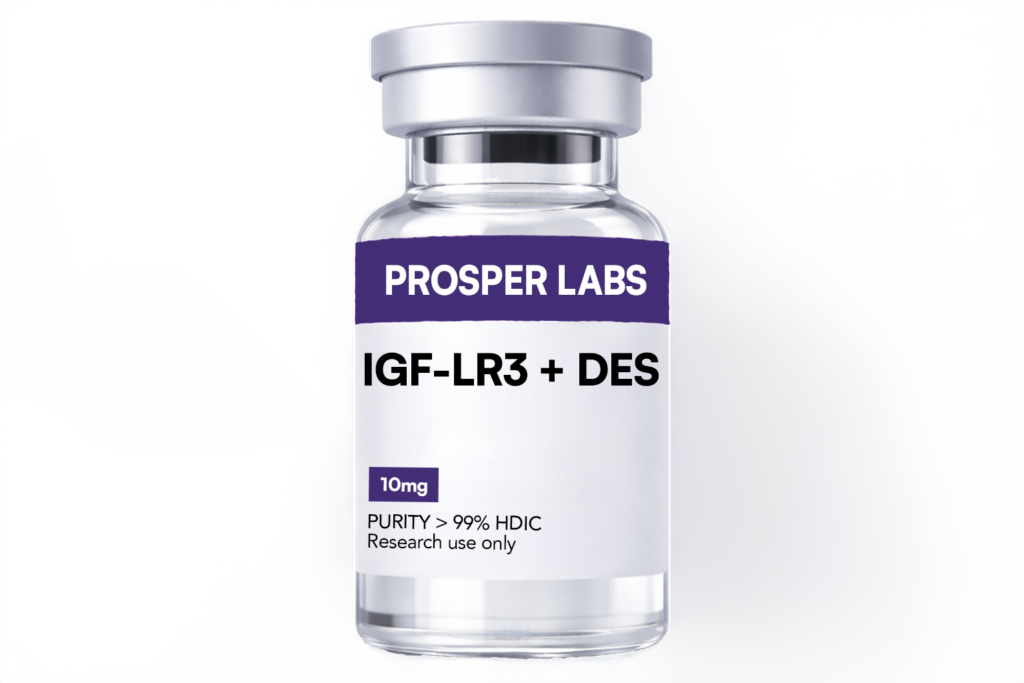
IGF 1 DES Des(1-3) Insulin Like Growth Factor 1 Truncated Analog | Research Use Only
What it is
IGF 1 DES is a recombinant, truncated analog of human insulin like growth factor 1 used for research applications. It corresponds to IGF 1 with the N terminal tripeptide removed, producing a shorter form that is commonly described in research literature as Des(1-3) IGF 1. In research reagent literature, this analog is frequently used in experimental systems where investigators want to study IGF signaling with less interference from IGF binding proteins.
Origins and design rationale
IGF 1 DES is commonly described in the literature as a naturally occurring truncated variant of IGF 1 that has been identified in sources such as bovine colostrum, human brain, and porcine uterus. Research discussions of DES(1-3) IGF 1 emphasize that its distinguishing feature is much lower binding to many IGF binding proteins, which is one reason it is often described as more potent than native IGF 1 in certain in vitro systems. Manufacturer and review literature also note that it binds the type 1 IGF receptor with similar affinity to full length IGF 1 while reducing sequestration by binding proteins.
Molecular profile
IGF 1 DES differs from native IGF 1 in one key structural way
• It lacks the first three N terminal amino acids of IGF 1, namely Gly Pro Glu
• This produces a 67 amino acid peptide corresponding to residues 4 through 70 of IGF 1
A commonly referenced amino acid sequence for laboratory grade IGF 1 DES is TLCGAELVDALQFVCGDRGFYFNKPTGYGSSSRRAPQTGIVDECCFRSCDLRRLEMYCAPLKPAKSA.
Reference mass information for laboratory grade IGF 1 DES is often listed around 7.4 kDa, and one reagent datasheet lists a molecular mass of 7,372 Dalton.
Scientific overview
In simplified terms, IGF 1 DES is used to study IGF 1 receptor driven signaling while reducing confounding from IGF binding proteins. In a mechanistic context, weaker binding to IGF binding proteins can increase the fraction of free ligand available to engage the receptor in experimental systems. This feature is one reason the literature often describes des(1-3)IGF I as more potent than native IGF I in cultured cell proliferation and hypertrophy models.
What researchers study with IGF 1 DES
Key research focus areas often include
• IGF 1 receptor signaling pathways in vitro
• Cell growth and proliferation models
• Hypertrophy and differentiation studies in cultured cells
• IGF binding protein interaction studies and how binding proteins modulate IGF responses
Regulatory and compliance notice
Research Use Only. Not for human or veterinary use. This description is provided for scientific context and must not be used to market IGF 1 DES for diagnosis, cure, mitigation, treatment, or prevention of disease. Manufacturer product literature for recombinant DES(1-3) IGF 1 explicitly states that the material is offered for research purposes only and is not approved for human or diagnostic use.
Citations and references
ScienCell Research Laboratories recombinant Human DES1-3/IGF1 product sheet, includes the 67 amino acid description, loss of Gly Pro Glu, sequence, molecular weight of 7.4 kDa, similar type 1 IGF receptor affinity, and reduced IGF binding protein binding.
Novus Biologicals recombinant Human IGF I/IGF 1 DES (1-3) product page, includes the full amino acid sequence, theoretical molecular weight of 7.4 kDa, background on isolation from bovine colostrum, human brain, and porcine uterus, and RUO limitation statement.
Biomol datasheet for Insulin Like Growth Factor I Des (1-3), human recombinant, includes the 67 amino acid description and molecular mass of 7,372 Dalton.
Ballard et al. review on des(1-3)IGF I as a truncated form of insulin like growth factor I, describing reduced IGF binding protein affinity and greater potency in cultured cell systems.
Francis et al. work on insulin like growth factors in bovine colostrum, supporting the early identification of a truncated IGF I form from bovine colostrum.