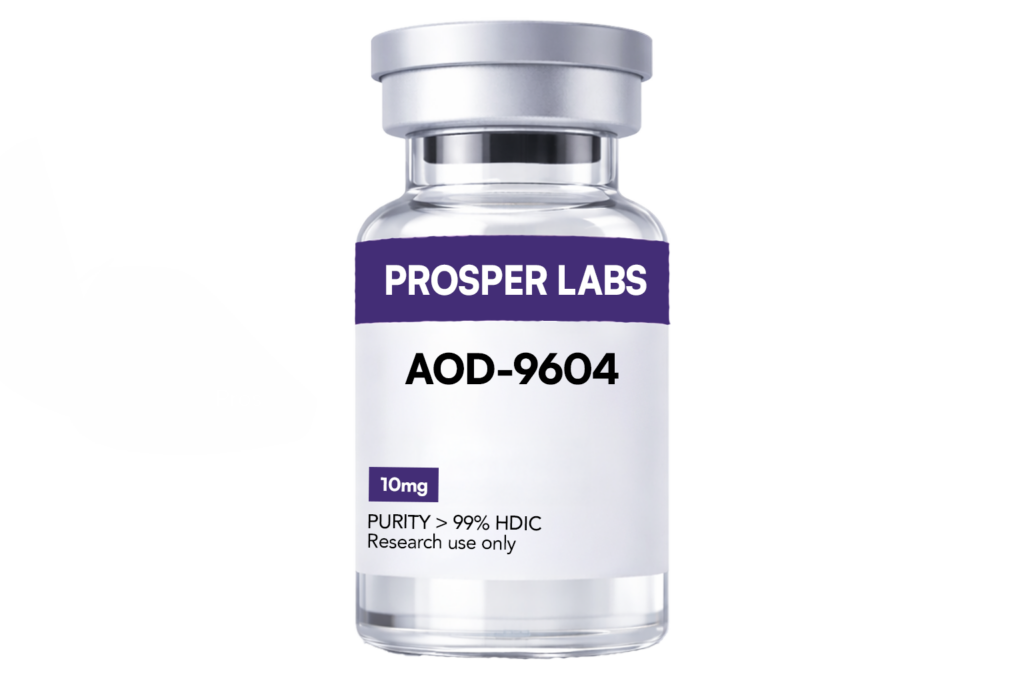
AOD-9604
For research / laboratory use only. Not for human consumption.
Product Description
AOD 9604 Human Growth Hormone Fragment 176 to 191 Analog | Research Use Only
What it is
AOD 9604 is a synthetic peptide derived from the C terminal region of human growth hormone. It is commonly described as the human growth hormone fragment 176 to 191, modified with an additional tyrosine at the N terminus, and it has been investigated in research settings focused on fat metabolism related biology. A widely cited sequence for the human growth hormone fragment 176 to 191 is YLRIVQCRSVEGSCGF, which appears in research describing structure modeling of the fragment. (pmc.ncbi.nlm.nih.gov)
Origins and development
AOD 9604 emerged from research attempts to isolate specific lipolytic related activity associated with growth hormone into a shorter peptide fragment, with the goal of studying those effects separately from the full endocrine profile of intact growth hormone. This concept appears in endocrinology literature evaluating growth hormone fragments and in obesity pharmacotherapy reviews summarizing investigational approaches. (academic.oup.com) (pmc.ncbi.nlm.nih.gov)
Molecular profile
PubChem lists AOD 9604 with molecular formula C78H123N23O23S2 and a molecular weight of 1815.1 g per mol. PubChem also lists a related acetate form with molecular weight 1875.1 g per mol. (pubchem.ncbi.nlm.nih.gov) (pubchem.ncbi.nlm.nih.gov)
Scientific overview
In simplified terms, AOD 9604 is studied as a short growth hormone derived fragment intended to probe lipid metabolism signaling without reproducing the full spectrum of growth hormone physiology. The scientific question researchers test is whether a specific sequence fragment can retain a targeted biological effect profile while avoiding other pathways associated with full length growth hormone, and outcomes depend heavily on the model system, exposure conditions, and measurement endpoints. (academic.oup.com)
Clinical research
AOD 9604 is not FDA approved. A review of obesity pharmacotherapy notes that a 12 week randomized clinical trial reported greater average weight loss in an AOD 9604 group versus placebo, but development was later discontinued after a larger 24 week trial did not show sufficient clinical effect. A separate publication focused on safety and tolerability reported no effect on serum IGF 1 and described tolerability findings in obesity related studies. (pmc.ncbi.nlm.nih.gov) (jofem.org)
What researchers study with AOD 9604
Key research focus areas often include
• Mechanistic comparisons between intact growth hormone and specific fragment activity in experimental systems (academic.oup.com)
• Lipid metabolism endpoints in preclinical models and early clinical exploration summarized in obesity pharmacotherapy literature (pmc.ncbi.nlm.nih.gov)
• Peptide related characterization considerations such as impurities and immunogenicity risk flagged by FDA in compounding safety discussions (fda.gov)
Regulatory and compliance notice
Research Use Only. Not for human or veterinary use. The FDA lists AOD 9604 among bulk drug substances that may present significant safety risks for compounding, citing immunogenicity risk for certain routes, complexities related to peptide impurities and API characterization, and limited safety related information. FDA briefing materials also discuss safety concerns and limited clinical safety information for AOD 9604 related bulk substances. (fda.gov) (fda.gov)
Citations and references
-
PubChem. AOD 9604 compound record, includes molecular formula and molecular weight.
(pubchem.ncbi.nlm.nih.gov) -
PubChem. AOD 9604 acetate compound record, includes molecular weight and relationship to parent compound.
(pubchem.ncbi.nlm.nih.gov) -
Misra M. Obesity pharmacotherapy review summarizing AOD 9604 clinical trial outcomes and discontinuation of development. Diabetes, Metabolic Syndrome and Obesity (2013).
(pmc.ncbi.nlm.nih.gov) -
Stier H, et al. Safety and tolerability of the hexadecapeptide AOD 9604 in obesity related studies, includes IGF 1 findings and tolerability discussion. Journal of Endocrinology and Metabolism (2013).
(jofem.org) -
Heffernan M, et al. Endocrinology paper describing AOD 9604 as a synthetic growth hormone fragment with a tyrosine addition at the N terminus. Endocrinology (2001).
(academic.oup.com) -
Habibullah MM, et al. Paper referencing the human growth hormone fragment 176 to 191 peptide sequence used in structural modeling. (2022).
(pmc.ncbi.nlm.nih.gov) -
FDA. Certain bulk drug substances that may present significant safety risks for compounding, includes AOD 9604 entry.
(fda.gov) -
FDA briefing materials on AOD 9604 related bulk drug substances and safety concerns for compounding.
(fda.gov)
Storage & Handling
Store in a cool, dry place away from direct light.
COA / Testing
Certificate of Analysis coming soon. Every batch is third-party tested at >99% HPLC purity.
Shipping
Same-day shipping on orders placed before 12:00 PM PST · 2–3 day delivery via USPS Priority. Discreet packaging.